
Late one night, while tidying up my living room, I realized something: I had been using many of my appliances for years without truly understanding their “actual condition”—I simply kept using them because they still worked.
I opened Lotte iMall, initially just to browse for a potential replacement air purifier, but that single click drew me into a completely different shopping paradigm.
It wasn’t about “selecting products” in the traditional sense; rather, it was a decision-making process driven by continuous live-streamed content. You could even say I wasn’t just browsing an e-commerce site, but entering a “consumer space defined by constant explanation.”
From “Casual Browsing” to the Rhythm of Live Streaming: A Reorganized Shopping Experience
Lotte iMall’s interface seemed ordinary at first, but I quickly noticed that most key products weren’t displayed as static images; instead, live TV-style shopping content was directly embedded.
Home appliances, in particular, seemed to default to a “demonstration mode.” The screen didn’t just show simple product photos; a presenter was on-site, operating the device and explaining details—such as filtration systems, noise levels, and mode-switching logic—in real-time.
This experience differed fundamentally from the e-commerce I was used to: previously, I had to actively try to understand the product, whereas here, the product was actively “demonstrating itself.”
More importantly, these live streams weren’t isolated; they constantly branched out into new recommendation paths. I had originally set out to look for an air purifier, but I was soon drawn into broader concepts like improving bedroom environments, upgrading kitchen appliances, and even comprehensive home cleaning solutions.
My shopping objectives were subtly “expanded” during this process.
The Other Side of Livestream E-commerce: Products “Deconstructed into Understandable Actions”
What truly shifted my perspective was an experience watching a livestream dedicated to a specific product.
On a standard e-commerce page, I might simply check the material, dimensions, and price before comparing different options. However, within Lotte iMall’s livestreaming ecosystem, products undergo a real-time explanation process that presents usage scenarios in a way that feels almost like a live demonstration.
During one particular broadcast featuring a set of functional cooling pads and pillowcases, the host didn’t just list fabrics or specifications. Instead, they laid out the entire bedding set and simulated various environments to demonstrate the actual cooling experience in a summer bedroom—covering details like the sensation against the skin, heat dissipation when tossing and turning, and comfort levels under different usage conditions.
The essence of this presentation style lies in transforming the decision-making process from one based on “specs and data” to one based on “understanding the actual experience.” You no longer have to rely on imagination to judge if a product suits you; the livestream allows you to see firsthand how it performs in real-life scenarios.
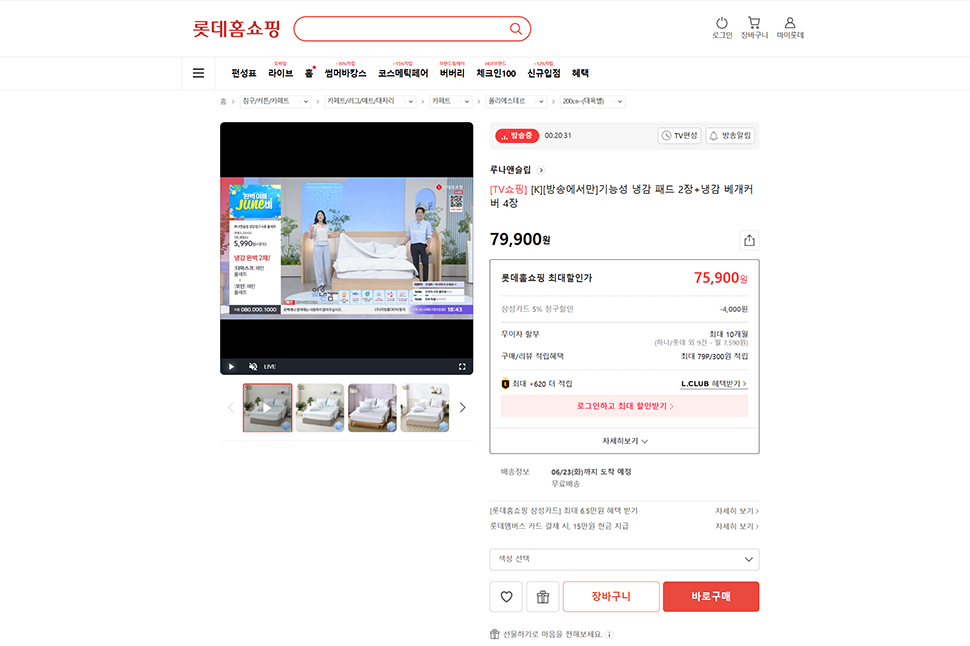
This is particularly crucial for lifestyle products with higher price points and an experiential nature. It addresses not just the question of “is it worth buying?” but the more specific inquiry: “what will it feel like in my home?”
At that moment, my focus shifted away from the product itself and toward how it would integrate into my life—considering bedroom temperature, sleep comfort, and the nuances of daily use.
In a sense, this style of livestreaming transforms shopping from a mere act of “selecting a product” into “experiencing a part of life in advance.”
AI Hosts and Short-Form Video: Shopping as a Continuous Stream of Content
Beyond live streams featuring human hosts, I gradually realized that the platform no longer relies on fixed broadcast schedules. Instead, through the use of AI virtual hosts and short-form video content, shopping has transformed into an activity that happens continuously.
The AI virtual hosts deliver explanations in a highly standardized yet efficient manner. Unlike human hosts who might rely on improvisation, the AI breaks down a product into specific, logical pathways for understanding: how usage scenarios align with household needs, the specific functional differences, how to choose from common bundle deals, and the best purchasing strategies for current promotions. The information structure is exceptionally clear, allowing one to gain a comprehensive understanding of the product in minimal time.
Short-form video content operates on a different logic, focusing more on quickly establishing a “first impression.” A clip might last only ten seconds—showing a floor washer’s cleaning performance on various surfaces or an air purifier’s operation in different settings like the bedroom or living room—yet it conveys information directly, helping you grasp what the product “can do” almost instantly.
When these two content formats are combined, the act of shopping is no longer tethered to a specific live broadcast time. Even if you aren’t “actively shopping,” the process of browsing content can continuously draw you into understanding the products, potentially leading to a purchase decision in a split second.
In a sense, Lotte iMall has moved beyond the model of “waiting for a live stream to buy something”; instead, there is a continuous flow of shopping content, and you are simply someone whose purchase intent is constantly being re-triggered.
A Genuine Household Procurement: From Replacing Single Items to a System-Wide Upgrade
Amidst the rhythm of content-driven engagement on Lotte iMall, my purchasing plans began to shift.
Initially, I only intended to replace my air purifier. However, after watching several live streams, I began to re-evaluate the state of my home appliances, eventually expanding the project into a systematic upgrade:
It was no longer just about replacing old equipment, but about reconfiguring how appliances were used throughout the home. For instance, while watching a livestream featuring cleaning equipment, I realized my home lacked a more efficient set of cleaning tools; while browsing kitchen appliances, I also picked up a few small gadgets I had previously considered “non-essential.”
Interestingly, this expansion wasn’t the result of aggressive upselling; rather, it happened naturally through the “continuous demonstration of usage scenarios.” The end result was an unplanned “home system upgrade.”
An Often Overlooked Advantage: Certainty Regarding After-Sales Service for Large Items
Throughout the experience, a crucial yet easily overlooked point was the clear explanation of after-sales support for large items.

During the livestream or product presentation, the following details were explicitly covered alongside the product itself:
- Installation process
- On-site service arrangements
- Return and exchange policies
- Ongoing maintenance procedures
For home appliances in particular, this type of information usually requires manual research on traditional e-commerce sites, but here, it was seamlessly integrated into the presentation.
This gave me a distinct feeling when making decisions: I knew not only “what I was buying” but also “what would happen after the purchase.” For high-ticket items, this sense of certainty is actually more important than discounts.
Extending the Rakuten Ecosystem: Consumption Beyond a Single Platform
As I continued to use the service, I gradually became aware of an underlying structure: the entire consumption experience was integrated into the Rakuten ecosystem.
Points earned from online purchases could be used within the offline Rakuten network. This meant my consumption wasn’t confined to a single platform but circulated within a much broader retail network.
This design transformed shopping from a one-off transaction into a cumulative experience.
Shopping Evolves from Product Selection to Understanding Lifestyle
After my experience with Lotte iMall, my biggest takeaway wasn’t simply that I had “bought better products,” but that my understanding of the shopping process itself had changed.
It used livestreams to turn products into “understandable processes,” replaced static lists with continuous content streams, lowered decision-making risks by providing service and after-sales information, and extended consumption value through an ecosystem. Ultimately, what emerged was not merely an e-commerce platform, but a comprehensive decision-making system centered on household consumption.